The V-Model: Why It Matters More in AI-Assisted Development
Most software teams operate on an unspoken contract: if a feature passes its tests, clears QA, and triggers no alerts in staging, the code is generally considered good to ship.
For a long time, that was a reasonable trade-off for many applications. Not all software was mission-critical, and when a minor edge-case bug slipped through to production, teams knew they could address it through subsequent updates. They accepted some uncertainty about correctness in exchange for faster releases.
In that world, the V-model took a back seat. Mention the V-model to many software engineers today, and they picture binders of stale requirements, eighteen-month waterfall delivery cycles, and compliance officers demanding signatures on documents nobody reads.
But that's a misunderstanding of what the V-model actually is.
The V-model was never about bureaucracy or slow delivery. It was invented to solve a specific engineering problem: how to build a system where you can demonstrate, with evidence, that requirements and architectural decisions have been followed.
Regulated and mission-critical engineering teams—in aerospace, medical devices, automotive, and core financial systems—rely on this shape because they do not have the luxury of the hotfix. If their code fails, someone gets hurt, planes divert, or millions of dollars vanish.
Now you may not be building avionics or pacemakers. But as autonomous agents begin generating significant portions of your codebase, you are suddenly facing the exact same challenge those teams solved decades ago: how do you know—with hard evidence, rather than hope—that the system matches what you decided to build?
Reliability is knowable adherence, not cleverness
In standard software development, "reliability" is often treated as a character trait of the team. We hire smart people, we ask them to write clean code, we encourage comprehensive unit tests, and we hold rigorous code reviews.
Those are good practices. But they do not give you knowable adherence.
Knowable adherence means something much stricter:
- You can point to any specific business requirement and immediately identify the tests and results that provide evidence of whether it has been satisfied.
- You can point to any architectural boundary or design decision and immediately identify the exact integration or unit test that proves it wasn't bypassed.
- If an unauthorized feature, an unagreed shortcut, or a violation of an architectural constraint creeps into the codebase, the corresponding verification checks can detect it before the code is merged.
If you cannot point to those links, you do not know your system is correct. You are assuming it is correct because your pipeline is green and your colleagues are competent.
Other development habits—writing a loose ticket, letting an engineer or an agent generate the code, writing a handful of tests against that code, and reviewing the diff—can certainly produce working software. But they cannot produce demonstrable proof that you built the right product and built the product right.
Why mission-critical engineering uses the V
Teams in safety-critical and high-stakes domains didn't adopt the V-model because they loved documentation. They adopted it because "it seemed to work in our staging environment" is an unacceptable defense during an incident investigation.
The only question that matters is: Did this software adhere to its specified design contracts, and did teams verify that adherence before deployment?
To guarantee that answer, they needed a closed-loop control system:
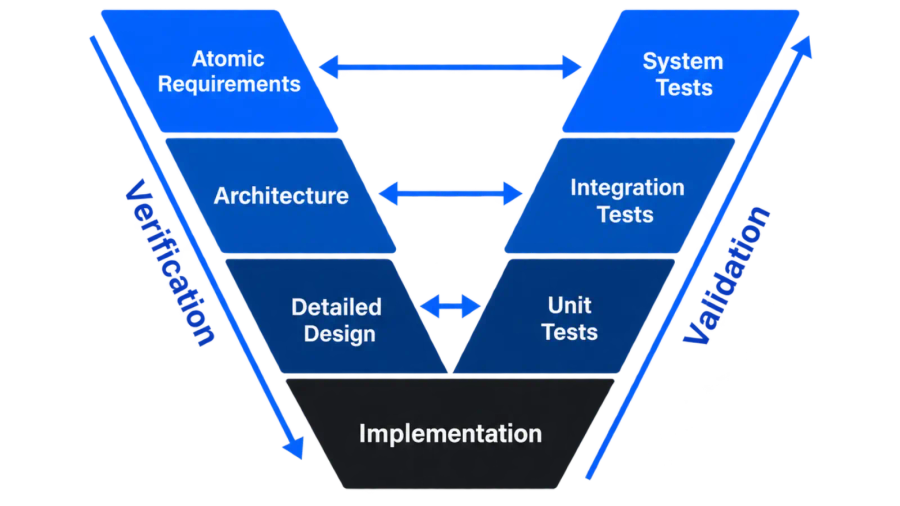
Look at the mechanics of this system:
- Vertical decomposition forces completeness: Here, teams don’t jump straight from a vague user goal to writing code. Instead, they are forced to break the goal into atomic requirements, decompose those requirements into explicit architecture (how data flows across components), and decompose that architecture into detailed contracts (schemas, API boundaries, error models).
- Horizontal verification forces honesty: Every layer on the left has a matching check on the right. Tests do more than check whether the code works; they help verify that the implementation meets its specification. Unit tests check detailed contracts. Integration tests check architectural boundaries. System tests check atomic requirements.
- Bidirectional mapping prevents drift: Every design decision must trace back to a requirement, helping identify unnecessary additions or scope creep. Every requirement must trace forward to a design, helping ensure no agreed-upon capability is forgotten.
In a mission-critical system, adherence is not an opinion voiced in a pull request comment but a verified structural fact.
What "adhered to" actually means on both legs
It is worth pausing on what adherence means in practice, because this is where modern engineering teams often deceive themselves.
1. Adherence on the right-product leg
A requirement is adhered to when the product exhibits the behavior defined in the requirement, supported by tests that verify whether the specified behavior has been met.
2. Adherence on the product-right leg
An architectural decision is adhered to when the implementation follows the structural constraints agreed upon by the team, supported by verification checks that can detect deviations from those constraints.
Without the left side written down in atomic, structured pieces, "adherence" has no meaning.
And without the right side mapped directly across, adherence is just an assumption based on a cursory glance at a diff.
Why this is no longer just for regulated industries
For years, mainstream software engineering could operate without explicitly following the V-model. Why? Because certain human constraints helped keep things in check:
- Human typing speed was a natural governor: An engineer writing code by hand could only produce a few dozen to a few hundred lines of meaningful logic in a day. Changes arrived in sips, not firehoses.
- Tribal knowledge lived in the room: Senior engineers carried the unwritten architectural constraints in their heads. They knew that module X shouldn't talk to database Y. When they reviewed a colleague's pull request, they caught boundary violations because they remembered why those boundaries were established in the first place.
Autonomous coding agents have completely shattered both of those safeguards.
First, generation speed has outpaced human review capacity. An agent can generate files, restructure services, and write lines and lines of code in much less time. The sheer volume of incoming diffs makes deep, manual line-by-line verification impossible.
Second, agents don't carry the same tribal memory and context that human engineers accumulate over time. An LLM may not know why your team decided to avoid a specific database pattern 6 months ago. It does not know that your company's security policy forbids exposing certain IDs in client-side URLs. Unless that constraint is explicitly provided in its working context, the agent will optimize for the immediate prompt: make the code run, make the test pass, and finish the job.
When you combine massive code generation volume with limited access to tribal knowledge, the old way of working (loose tickets followed by subjective code review) collapses under the weight of subtle regressions and architectural drift.
This is why the V-model is suddenly the most relevant engineering concept in modern AI delivery. It provides the exact structural guardrails that autonomous agents need:
- It gives the coding agent an explicit, unambiguous blueprint to build against.
- It gives the testing framework the exact contracts it must verify.
- It gives engineering leaders the only reliable way to know that the generated code is both what was intended and how it was intended to be built.
Moving from hope to proof
You do not need to adopt heavy aerospace documentation templates or halt your continuous deployment pipelines to use the V-model. The V-model is not a release schedule; it is an engineering mental model.
It simply says:
- Don't ask an agent to implement a feature until you have sliced intent into atomic requirements.
- Don't allow an agent to invent the architecture in the pull request; define the sequences, conditions, and contracts upfront.
- Don't accept tests that merely validate whatever code the agent generated; ensure your tests explicitly verify the requirements and the design decisions.
When you do this, you stop relying on heroics and hope during code review. You know you built the right product because every requirement is verified. You know you built the product right because every architectural decision is enforced.